
How to Choose a Forklift Battery: 9 Essential Factors to Consider
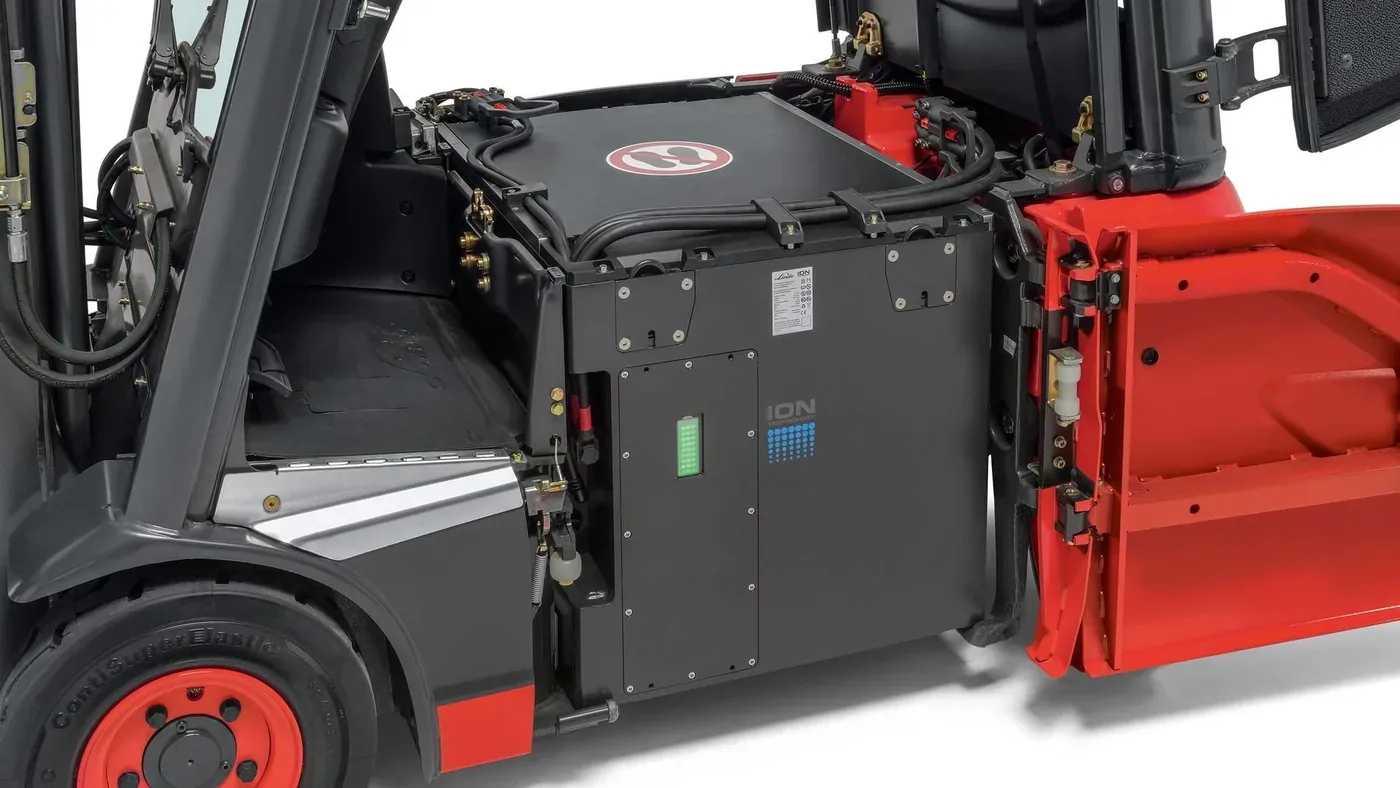
Choosing the right forklift battery is essential for maintaining reliable warehouse operations, reducing downtime and managing long-term operating costs.
A battery must do more than provide sufficient energy. It must also match the forklift's electrical system, physical battery compartment, weight requirements, power demands and charging infrastructure.
This becomes particularly important when replacing a traditional lead-acid traction battery with a lithium iron phosphate (LiFePO4) system.
The nine essential factors in forklift battery selection are vehicle compatibility, battery chemistry, voltage, energy capacity, current capability, battery weight, physical dimensions, charger integration and total cost of ownership.
This guide explains how to evaluate each factor before making a purchasing decision.
1. Identify the Forklift's Technical Requirements
The first step is to review the forklift manufacturer's specifications.
Two forklifts with the same rated lifting capacity may require entirely different battery systems.
Before selecting a replacement battery, collect the following information:
Forklift manufacturer and model
Serial number and manufacturing year
Required battery voltage
Minimum and maximum permitted battery weight
Battery compartment dimensions
Existing battery connector
Charger specifications
Relevant manufacturer instructions and approval requirements
The forklift data plate, operating manual and existing battery label are useful starting points.
A replacement battery should be evaluated against the actual vehicle configuration rather than selected solely by lifting capacity.
2. Compare Lead-Acid and LiFePO4 Technologies
Conventional lead-acid traction batteries remain widely used in electric forklifts. LiFePO4 batteries offer an alternative for applications where charging flexibility, maintenance requirements and long-term operating efficiency are important.
| Feature | Lead-Acid Battery | LiFePO4 Battery |
|---|---|---|
| Initial investment | Generally lower | Generally higher |
| Energy density | Typically lower | Typically higher |
| Cycle life | Depends on use and maintenance | Can be longer under suitable conditions |
| Charging requirements | Lead-acid-specific charging profile | Compatible lithium charging profile |
| Maintenance | Flooded versions require electrolyte maintenance | No electrolyte watering |
| Opportunity charging | Depends on battery design | Often practical in compatible systems |
| Battery management | Chemistry-specific monitoring and protection | Cell-level monitoring through a BMS |
Neither battery chemistry is automatically the best choice for every operation.
The decision should consider shift schedules, energy consumption, charging availability, maintenance resources and overall cost.
3. Verify Battery Voltage Compatibility
Forklifts are available in several voltage classes, including 24V, 36V, 48V and 80V.
However, nominal voltage is not necessarily identical across different battery chemistries.
For example, a conventional 48V lead-acid traction battery may contain 24 cells rated at approximately 2V each.
A LiFePO4 battery consisting of 16 cells connected in series has a nominal voltage of 51.2V.
A 51.2V LiFePO4 system may therefore be considered for certain 48V-class forklift applications.
Nevertheless, compatibility must be verified across the entire operating voltage range.
The motor controller, electrical accessories, protection system and charger must all be suitable for the proposed battery configuration.
Matching the nominal voltage alone is insufficient.
4. Select Capacity Based on Energy Demand
Battery capacity is commonly expressed in ampere-hours (Ah).
However, energy measured in watt-hours (Wh) or kilowatt-hours (kWh) provides a more meaningful basis when comparing batteries with different nominal voltages.
The nominal energy calculation is:
Energy (kWh) = Nominal Voltage (V) × Capacity (Ah) / 1000
Example Calculation
Consider a LiFePO4 battery rated at 51.2V and 300Ah.
51.2 × 300 / 1000 = 15.36 kWh
Its nominal stored energy is 15.36 kWh.
If 80% of this energy is assumed to be usable:
15.36 × 0.80 = 12.29 kWh
Assuming an average battery-side power demand of 4 kW:
12.29 / 4 = Approximately 3.07 hours
This is an illustrative calculation, not a guaranteed forklift runtime.
Actual operating time depends on:
Load weight
Lifting frequency
Travel distance
Floor conditions and gradients
Motor and hydraulic efficiency
Ambient and battery temperature
Battery condition
BMS operating limits
For accurate battery sizing, real operating data should be evaluated whenever possible.
5. Evaluate Continuous and Peak Discharge Current
Two batteries with identical voltage and Ah ratings can have very different power delivery capabilities.
Forklift traction and hydraulic lifting systems may demand substantial current, particularly during acceleration or demanding lifting operations.
The battery system must support both continuous current requirements and short-duration peak loads.
The main specifications to review include:
Maximum continuous discharge current
Peak discharge current and permitted duration
Maximum charging current
Temperature-dependent current limits
BMS protection behavior
Regenerative current acceptance, where applicable
An undersized battery or incorrectly configured BMS may limit performance or interrupt power delivery under demanding conditions.
Current capability should be assessed against the forklift's measured or documented operating requirements.
6. Check Battery Weight and Vehicle Stability
Battery weight is a critical safety consideration.
In certain electric forklifts, the traction battery contributes to the vehicle's required mass and stability characteristics.
LiFePO4 battery cells can be substantially lighter than conventional lead-acid cells for a given energy requirement.
However, reduced battery weight is not necessarily beneficial in a forklift application.
Replacing a heavy lead-acid battery with a significantly lighter lithium battery without considering vehicle stability can create serious safety concerns.
Always verify:
Manufacturer-specified minimum and maximum battery weight
Required battery positioning
Battery center of gravity
Mechanical retention and securing systems
Any manufacturer approval required for conversion
Where additional ballast is necessary, its design and installation should be evaluated and approved through the appropriate engineering and manufacturer procedures.
7. Confirm Dimensions and Mechanical Integration
A forklift battery must fit securely within the designated battery compartment.
Review:
Overall battery length, width and height
Cable routing and connector positioning
Terminal polarity
Connector current rating
Battery mounting and retention
Lifting and handling provisions
Resistance to vibration and mechanical stress
Environmental protection requirements
Mechanical compatibility is not simply about fitting the battery into the available space.
Safe installation, accessibility and appropriate retention are equally important.
8. Verify Charger and BMS Compatibility
A charger originally designed for a lead-acid battery may not be suitable for a LiFePO4 system.
The charging voltage, current limits, charging algorithm and communication requirements must be reviewed.
Why Does the BMS Matter?
A Battery Management System (BMS) supports safe and reliable lithium battery operation by monitoring operating parameters and controlling protective functions.
Depending on the system design, the BMS can:
Monitor individual cell voltages
Measure battery temperatures
Monitor charge and discharge current
Manage cell balancing
Apply overcharge and overdischarge protection
Communicate with the forklift or charger
Some modern forklifts use CAN-based communication between the vehicle, battery and charging equipment.
Physical connector compatibility alone does not guarantee that the systems can exchange the required information.
The communication protocol and control functions must also be compatible.
Charging temperature limits are another important consideration. Some LiFePO4 systems restrict or prevent charging below 0°C unless specifically engineered for lower-temperature operation.
Always follow the battery manufacturer's specifications.
9. Calculate the Total Cost of Ownership
The purchase price represents only one part of a forklift battery investment.
A more complete evaluation should include:
Initial battery cost
Charger and electrical infrastructure
Installation and conversion requirements
Energy consumption
Preventive maintenance
Expected battery replacement intervals
Downtime and operational interruptions
Warranty terms
Technical service availability
End-of-life handling and recycling
For multi-shift operations, charging flexibility and reduced interruptions may have significant economic value.
However, the benefits vary between applications. A realistic comparison should use the facility's actual operating schedule and energy requirements.
Forklift Battery Selection Checklist
| Technical requirement | Why it matters |
|---|---|
| Forklift make and model | Vehicle compatibility |
| System voltage | Electrical integration |
| Battery capacity (Ah/kWh) | Operating duration |
| Continuous and peak current | Drive and lifting performance |
| Battery weight | Vehicle stability |
| Physical dimensions | Mechanical fit |
| Connectors and terminals | Electrical safety |
| BMS and communication | Protection and system integration |
| Charging equipment | Safe and suitable charging |
| Test and compliance documents | Technical assurance |
| Warranty and service | Long-term operating cost |
Safety Standards and Documentation
Industrial lithium battery systems should be evaluated against applicable safety requirements.
IEC 62619 addresses safety requirements for rechargeable lithium cells and batteries used in industrial applications, including certain motive-power applications.
IEC 62485-3 addresses safety aspects associated with traction battery installations and their use, inspection and maintenance.
Compliance with a standard should only be claimed when supported by valid documentation for the specific product.
Frequently Asked Questions
What voltage should a forklift battery have?
Forklifts use different voltage classes, including 24V, 36V, 48V and 80V. The correct voltage must be verified using the vehicle manufacturer's specifications.
How many amp-hours does a forklift battery need?
The required Ah rating depends on system voltage, energy consumption, shift duration and charging opportunities. Ah alone is not sufficient to determine runtime.
Can a lead-acid forklift battery be replaced with lithium?
In some applications, yes. However, voltage compatibility, battery weight, dimensions, charger integration, BMS functionality and manufacturer requirements must be evaluated before conversion.
Are LiFePO4 forklift batteries longer-lasting?
LiFePO4 batteries may offer longer cycle life under suitable operating conditions. Actual service life depends on temperature, depth of discharge, charging practices and battery design.
Can I use my existing forklift charger?
Not necessarily. A lead-acid charger should not be used unless its compatibility with the specific lithium battery system has been verified.
Is a lighter lithium battery always better?
No. Some forklifts rely on battery mass as part of their stability design. The replacement battery must comply with the vehicle manufacturer's weight and installation requirements.
Conclusion: The Right Forklift Battery Starts With the Right Technical Assessment
Selecting a forklift battery requires more than matching voltage and capacity.
Electrical performance, mechanical integration, battery weight, charging infrastructure and long-term operating conditions must all be considered.
LiFePO4 technology can provide significant advantages in suitable industrial applications, but achieving those benefits depends on correct system design and integration.
Looking for a Lithium Battery Solution for Your Forklift?
Mastiff Energy focuses on industrial LiFePO4 battery engineering and application-specific battery solutions.
Share your forklift model, existing battery specifications, battery compartment dimensions and operating requirements to request a technical evaluation.