
Lithium vs Lead-Acid Forklift Batteries: Which Is Better for Your Operation?
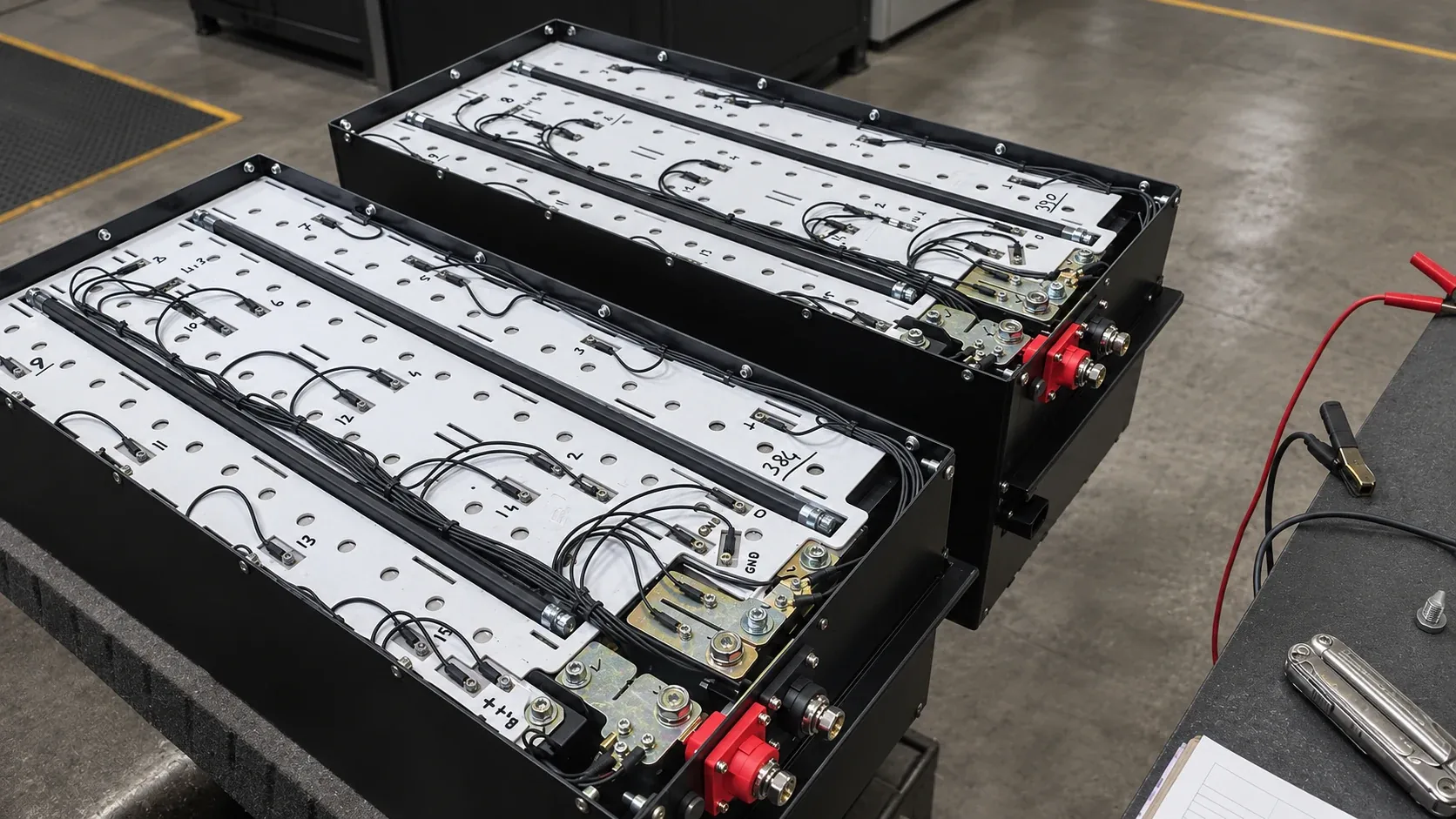
Choosing the right battery technology is an important decision for businesses operating electric forklifts.
For many years, lead-acid traction batteries have been the standard power source for electric material-handling equipment. Today, lithium iron phosphate (LiFePO4) batteries offer an alternative, particularly for operations requiring flexible charging, reduced routine maintenance and high equipment availability.
However, the question is not simply whether lithium technology is better than lead-acid technology.
The most suitable forklift battery depends on operating hours, energy consumption, charging infrastructure, vehicle compatibility and total cost of ownership.
This article compares both technologies from a technical and economic perspective.
1. Understanding the Two Battery Technologies
Lead-Acid Forklift Batteries
Traditional forklift traction batteries commonly use flooded lead-acid chemistry, including PzS and PzB tubular-plate cell designs.
These batteries store and release energy through electrochemical reactions involving lead-based electrodes and sulfuric-acid electrolyte.
Their main characteristics include:
Established industrial technology
Generally lower initial acquisition cost
Proven use in repeated charge-discharge applications
Periodic electrolyte maintenance for flooded versions
Specific charging and ventilation requirements
Battery performance and service life depend significantly on proper charging, operating conditions and maintenance.
LiFePO4 Forklift Batteries
Lithium iron phosphate batteries belong to the lithium-ion battery family.
An industrial LiFePO4 battery system typically includes battery cells, electrical interconnections, a protective enclosure, switching and protection components, and a Battery Management System (BMS).
Potential advantages include:
High cycle-life potential
High energy efficiency
Reduced routine electrolyte-related maintenance
Flexible opportunity charging in compatible applications
Electronic cell monitoring and protective functions
Application-specific battery configurations
However, safe and reliable operation still requires appropriate battery engineering, charger compatibility, thermal management and integration with the forklift.
2. Lithium vs Lead-Acid: Technical Comparison
| Factor | Flooded Lead-Acid | LiFePO4 |
|---|---|---|
| Initial investment | Generally lower | Generally higher |
| Cycle-life potential | Depends on maintenance and use | Can be higher under suitable conditions |
| Energy efficiency | Generally lower | Generally higher |
| Charging time | Often longer in conventional systems | Can be shorter with compatible equipment |
| Opportunity charging | Requires suitable charging strategy | More flexible in compatible systems |
| Electrolyte watering | Required | Not required |
| Energy density | Lower | Higher |
| Battery weight | Usually higher | May be lower for comparable energy |
| Battery monitoring | Depends on system design | Cell-level monitoring through BMS |
| Cold-temperature performance | Capacity and charging may be affected | Charging restrictions may apply |
| Retrofit requirements | Often compatible with original equipment | Technical assessment may be necessary |
| Total cost of ownership | Application-dependent | May be favorable in intensive operations |
These are general characteristics. Actual performance must be assessed using the specifications of the battery systems being compared.
3. Charging Time and Operational Flexibility
Charging time is one of the most important considerations for warehouses and production facilities operating multiple shifts.
Charging Lead-Acid Batteries
Conventional flooded lead-acid traction batteries can require several hours for a complete charging cycle.
Additional cooling time may be needed, depending on the battery design and operating conditions.
Some charging strategies also require periodic equalization.
In demanding operations, this may result in the need for:
Spare batteries
Battery-changing equipment
Dedicated charging areas
Planned maintenance periods
Charging and cooling schedules
Fast-charging and opportunity-charging solutions are also available for certain lead-acid systems, but they must be compatible with the battery and operating strategy.
Charging LiFePO4 Batteries
LiFePO4 systems can support relatively high charging currents when the cells, BMS and charging equipment are designed accordingly.
This makes opportunity charging possible in suitable operations.
For example, a forklift may be connected to a compatible charger during lunch breaks or shift changes.
The energy added during these periods can reduce the need for extended charging downtime.
However, actual charging speed depends on:
Battery capacity
Maximum permissible charge current
Charger output power
Initial state of charge
Battery temperature
BMS charging limits
Example Charging Calculation
Suppose a battery needs to receive 20 kWh of energy.
If the average net charging power delivered to the battery is 10 kW:
20 kWh / 10 kW = 2 hours
This is an idealized energy calculation.
Actual charging may take longer because the charging current can decrease as the battery approaches its upper state-of-charge limit.
4. Battery Cycle Life and Service Life
Battery service life is influenced by more than the number of charge-discharge cycles.
A full equivalent cycle approximately represents the discharge of energy corresponding to the battery's rated capacity.
For example, two separate discharges of 50% of rated capacity together represent approximately one full equivalent discharge cycle.
The main factors affecting battery life include:
Depth of discharge
Operating temperature
Average state of charge
Charge and discharge currents
Cell design and quality
Charging practices
Calendar aging
LiFePO4 cells can provide longer cycle life than many conventional lead-acid designs under suitable operating conditions.
However, specific lifespan claims should be supported by manufacturer test data.
When comparing batteries, the cycle-life test conditions must be equivalent, including temperature, depth of discharge and end-of-life capacity criteria.
5. Maintenance Requirements
Flooded lead-acid batteries require regular maintenance to maintain performance and safety.
Depending on the manufacturer's requirements, maintenance activities may include:
Checking electrolyte levels
Adding suitable distilled water
Inspecting terminals and connections
Following charging and equalization procedures
Maintaining appropriate charging-area ventilation
LiFePO4 batteries eliminate the need for electrolyte watering.
This can reduce routine maintenance work, particularly in large forklift fleets.
However, lithium batteries are not completely maintenance-free.
Electrical connections, mechanical retention, enclosure condition, cooling systems and BMS diagnostics may still require periodic inspection.
Maintenance procedures should always follow the specific battery manufacturer's documentation.
6. Energy Efficiency and Electricity Consumption
Battery systems experience energy losses during charging and discharging.
Losses arise from internal resistance, electrochemical processes, electrical connections and associated electronic components.
Properly designed LiFePO4 battery systems can provide higher energy efficiency than many conventional flooded lead-acid systems.
This can reduce electricity consumption for the same amount of useful energy delivered to the forklift.
The financial benefit depends on:
Annual energy throughput
Battery efficiency
Charger efficiency
Electricity prices
Operating schedule
For businesses operating large forklift fleets, even modest differences in energy efficiency can become financially significant over time.
A reliable comparison should use measured energy consumption whenever possible.
7. Battery Weight and Forklift Stability
LiFePO4 cells generally have higher energy density than lead-acid cells.
Consequently, lithium battery systems may be lighter for a comparable amount of stored energy.
In many electric vehicles, this can be an advantage.
However, forklifts require special consideration.
In some forklift designs, battery weight contributes to the vehicle's required mass and stability characteristics.
Replacing a heavy lead-acid battery with a substantially lighter lithium battery without proper engineering assessment may create safety concerns.
A conversion assessment should therefore include:
Minimum and maximum permitted battery weight
Battery center of gravity
Battery enclosure dimensions
Mechanical mounting and securing provisions
Vehicle manufacturer requirements
Any necessary weight adjustment must be designed and approved in accordance with the applicable manufacturer and engineering requirements.
8. Safety Considerations
Both technologies have specific safety requirements.
Lead-Acid Battery Safety
Flooded lead-acid batteries contain corrosive electrolyte.
Hydrogen gas can be released during charging, requiring appropriate ventilation, ignition-source controls and safety procedures.
LiFePO4 Battery Safety
LiFePO4 chemistry offers favorable thermal stability characteristics when correctly designed and operated.
Nevertheless, lithium battery systems require protection against:
Short circuits
Excessive current
Overcharging
Overdischarging
Excessive temperature
Mechanical damage
A properly engineered BMS, suitable protection devices and correct electrical installation are essential.
Neither technology is risk-free.
9. Limitations of LiFePO4 Forklift Batteries
Despite their benefits, lithium forklift batteries also have limitations.
Higher upfront cost: The initial investment may exceed that of a conventional lead-acid system.
Electronic integration: Battery management, protection systems and communication interfaces may be required.
Charger compatibility: Existing lead-acid chargers may not support the required lithium charging profile or communication protocol.
Cold-temperature charging: Some LiFePO4 systems restrict charging below 0°C. Specialized low-temperature or heated systems may have different specifications.
Retrofit engineering: Existing vehicles may require mechanical or electrical adaptation.
These limitations do not eliminate the advantages of lithium technology, but they must be considered during project planning.
10. Which Operations Benefit Most From Lithium Forklift Batteries?
Single-Shift Operations
For forklifts operating limited hours per day, an existing lead-acid system may remain economically attractive.
If overnight charging is sufficient and maintenance requirements are manageable, the additional investment in lithium technology may take longer to recover.
Multi-Shift Operations
Facilities operating two or three shifts may benefit from the flexibility of compatible LiFePO4 systems.
Potential benefits include:
Opportunity charging during scheduled breaks
Reduced dependence on spare batteries
Fewer battery-changing operations
Reduced routine electrolyte maintenance
Improved equipment availability
These benefits depend on correct energy sizing and charging infrastructure.
Large Forklift Fleets
For large warehouse or logistics operations, battery selection should be evaluated at fleet level.
Factors such as charging schedules, electricity consumption, maintenance labor and vehicle availability can have a substantial influence on total operating costs.
11. Total Cost of Ownership: Which Battery Is More Economical?
The initial purchase price does not represent the complete cost of a forklift battery.
A total cost of ownership (TCO) analysis should consider the following:
| Cost category | Evaluation |
|---|---|
| Battery purchase | Initial acquisition |
| Charger | Compatibility or replacement requirements |
| Electricity | Annual energy consumption |
| Maintenance | Labor, materials and inspections |
| Downtime | Lost productive time |
| Spare batteries | Additional battery requirements |
| Replacement | Battery renewals within the assessment period |
| Integration | Enclosure, wiring and communication modifications |
| End-of-life | Recycling and disposal costs |
A business may choose a five-year assessment period and compare both technologies using the same operating assumptions.
A simplified formula is:
TCO = Initial investment + Energy + Maintenance + Downtime + Replacement + Integration + End-of-life costs − Recoverable value
For a more complete financial analysis, future expenses can be discounted to present value.
Lithium systems may offer lower long-term costs in intensive applications.
Conversely, lead-acid systems may remain more economical in some low-utilization operations.
The correct conclusion requires application-specific data.
12. Before Converting a Forklift From Lead-Acid to Lithium
Before starting a battery conversion project, evaluate:
Forklift manufacturer and model
Existing battery voltage and capacity
Actual daily energy consumption
Number of operating shifts
Minimum and maximum permitted battery weight
Existing charger compatibility
Required BMS and communication interfaces
Regenerative current requirements, where applicable
Manufacturer approval and applicable safety requirements
A technically suitable battery must satisfy the forklift's electrical, mechanical and operational requirements.
Frequently Asked Questions
Are lithium batteries better than lead-acid batteries for forklifts?
LiFePO4 batteries can offer advantages in charging flexibility, maintenance and cycle life. However, the best option depends on operating intensity, cost and vehicle compatibility.
Do lithium forklift batteries last longer?
They may provide longer cycle life under suitable conditions. Actual service life depends on temperature, depth of discharge, charging practices and battery construction.
Can a lead-acid forklift battery be replaced with lithium?
Some forklifts can be converted, but voltage range, battery weight, charger compatibility, BMS integration and manufacturer requirements must be evaluated.
Do lithium forklift batteries charge faster?
They can charge faster when compatible cells, battery management and charging equipment are used. Charging speed is not identical for every lithium battery.
Are lithium forklift batteries maintenance-free?
They do not require electrolyte watering, but electrical, mechanical and electronic inspections may still be necessary.
Which forklift battery has a lower total cost?
The answer depends on operating hours, electricity use, maintenance expenses, charging infrastructure and replacement requirements.
Conclusion: Choose the Battery That Fits Your Operation
The choice between lithium and lead-acid forklift batteries should be based on more than initial purchase price.
Charging flexibility, maintenance requirements, energy efficiency, cycle life, equipment compatibility and total cost of ownership must all be considered.
LiFePO4 technology can offer valuable benefits in demanding industrial applications.
However, traditional lead-acid systems remain a practical option for certain operations.
The most effective decision is based on the forklift's technical specifications and the facility's actual operating data.
Considering a Lithium Battery Solution for Your Forklift?
Mastiff Energy focuses on industrial LiFePO4 battery engineering and application-specific battery solutions.
Share your forklift model, existing battery specifications and operating requirements to request a technical assessment.