
What Is a BMS? How Battery Management Systems Work in Lithium Batteries
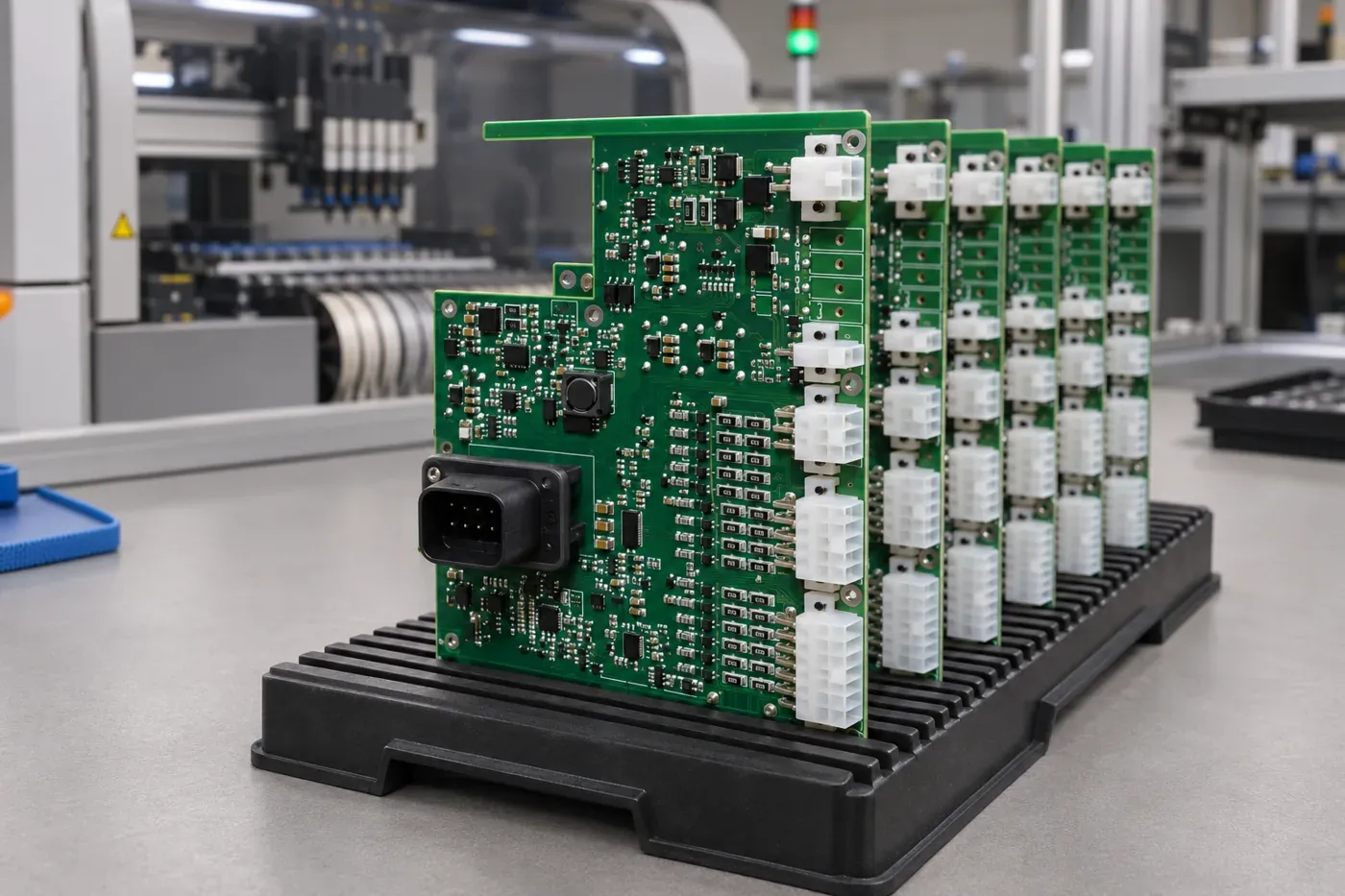
Lithium battery performance depends on more than cell quality and energy capacity.
To operate safely and reliably, a battery pack must monitor individual cell voltages, electrical current and operating temperatures. Charging and discharging must remain within the limits established for the specific cells and system design.
This is the role of the Battery Management System (BMS).
A BMS is an electronic hardware and software system that monitors, evaluates and manages the operating conditions of a rechargeable battery pack.
In industrial lithium iron phosphate (LiFePO4) batteries, the BMS plays a fundamental role in cell monitoring, fault protection, balancing, state estimation and integration with external equipment.
This article explains how BMS technology works and why its design matters in forklifts, golf carts, electric pallet trucks and industrial machinery.
1. What Is a Battery Management System?
A Battery Management System is an electronic system designed to monitor and manage the operating conditions of rechargeable battery packs.
Industrial lithium batteries may contain many cells connected in series and parallel.
Although the cells are selected to have similar characteristics, differences in capacity, internal resistance, temperature and aging behavior can develop over time.
The BMS monitors the battery system and helps prevent operation outside defined safety limits.
Its typical functions include:
Individual cell voltage monitoring
Battery current measurement
Temperature monitoring
Overcharge and overdischarge protection
Overcurrent and short-circuit fault detection
Cell balancing
State-of-charge estimation
State-of-health estimation
Communication with external equipment
Fault monitoring and diagnostics
The exact functions depend on the BMS architecture and application.
2. How Does a BMS Work?
A BMS typically operates through three main processes: measurement, evaluation and control.
Measurement
Voltage, current and temperature information is collected using sensors and electronic measurement circuits.
Evaluation
The control system compares measured values with the battery's defined operating limits.
It may also estimate battery condition using mathematical models and measurement history.
Control and Protection
Under normal conditions, the BMS allows the battery system to operate.
If an operating limit is approached or exceeded, the system may:
Request reduced charging current
Limit available discharge power
Send a warning or fault message
Command electronic switching devices or contactors to disconnect the battery
A BMS does not necessarily regulate traction motor current directly.
In many systems, it communicates permitted operating limits to a charger or vehicle controller, which then adjusts the power flow.
3. Why Does a BMS Monitor Individual Cell Voltages?
Monitoring total battery voltage alone does not provide sufficient information about the condition of every cell.
Consider a LiFePO4 battery with sixteen cells connected in series.
Its nominal voltage is:
16 × 3.2V = 51.2V
However, individual cell voltages may differ.
A cell could approach an operating limit while the total battery voltage still appears acceptable.
Example Cell Measurements
| Cell | Measured voltage |
|---|---|
| Cell 1 | 3.30V |
| Cell 2 | 3.31V |
| Cell 3 | 3.29V |
| Cell 4 | 3.45V |
| Total | 13.35V |
The total voltage does not reveal that Cell 4 has a higher voltage than the others.
Individual monitoring allows the BMS to identify differences and respond according to the battery's operating conditions.
Cell voltage differences must be interpreted in relation to temperature, state of charge, current and battery chemistry.
4. What Is Battery Cell Balancing?
Cells connected in series can gradually develop differences in their state of charge.
These differences may arise from manufacturing tolerances, self-discharge, capacity variation, temperature and aging.
Cell balancing is used to reduce differences in cell state of charge.
Two common approaches are passive and active balancing.
Passive Cell Balancing
Passive balancing dissipates energy from selected cells, typically through resistive circuits.
It is often relatively simple and economical, but the removed energy is largely converted into heat.
Active Cell Balancing
Active balancing uses electronic circuitry to transfer energy between cells or groups of cells.
It may provide more efficient energy redistribution in certain applications, but generally requires more complex hardware and control.
| Feature | Passive balancing | Active balancing |
|---|---|---|
| Principle | Dissipates selected cell energy as heat | Transfers energy between cells or groups |
| Circuit complexity | Generally lower | Generally higher |
| Energy efficiency | Energy is intentionally dissipated | Transfer losses occur, but efficiency can be higher |
| Cost | Often lower | Often higher |
| Suitability | Application-dependent | Application-dependent |
Balancing does not repair a damaged cell or restore lost battery capacity.
It helps manage state-of-charge differences within the limitations of the battery system.
5. How Does a BMS Protect Against Overcharge and Overdischarge?
Lithium cells must operate within defined voltage limits.
Exceeding those limits can reduce service life, damage cells or create safety risks.
Overcharge Protection
During charging, the BMS monitors individual cell voltages.
When a cell approaches its upper limit, the BMS may request reduced charging current or stop charging.
Overdischarge Protection
During discharge, the BMS can detect when a cell approaches its lower permitted voltage.
Depending on the architecture, it may issue a warning, request power reduction or disconnect the battery.
For vehicles and industrial machinery, sudden power interruption can create additional operating hazards.
Therefore, controlled power reduction, fault communication and safe shutdown behavior should be considered as part of system integration.
6. Why Does a BMS Measure Current and Temperature?
Current and temperature monitoring support safe operation and battery state estimation.
Current Measurement
Battery current changes according to equipment demand.
For example, an electric forklift may require increased current during acceleration or hydraulic lifting.
The BMS monitors current to evaluate operating conditions and detect potential overloads.
Current measurements can also support energy calculations and state-of-charge estimation.
Temperature Measurement
Cell and battery temperature influence:
Charging capability
Power delivery
Usable capacity
Battery aging
Safety limits
Temperature sensors provide information from selected locations within the battery system.
Their number and placement should be appropriate for the battery's thermal design.
Some LiFePO4 batteries restrict charging at low temperatures. Specific thresholds depend on the cell and battery manufacturer's requirements.
7. What Are SOC and SOH?
Two important terms in battery management are SOC and SOH.
State of Charge (SOC)
SOC represents an estimate of the battery's remaining charge relative to a defined capacity reference.
It is typically expressed as a percentage.
SOC is not measured directly.
Instead, the BMS may estimate it using current measurements, voltage, temperature and battery models.
One approach is coulomb counting, which integrates current over time.
Because measurement errors can accumulate, suitable correction or calibration methods may be necessary.
LiFePO4 cells have a relatively flat voltage profile over a substantial portion of their state-of-charge range, making voltage-only SOC estimation challenging.
State of Health (SOH)
SOH describes the battery's condition relative to a defined reference.
A capacity-based SOH estimate may be calculated as:
SOH (%) = Current measured capacity / Reference capacity × 100
For example, if a battery originally had 100Ah capacity and currently provides 85Ah under comparable test conditions:
85 / 100 × 100 = 85% SOH
However, SOH can also incorporate internal resistance, power capability and other indicators.
Therefore, SOH values from different BMS products are not necessarily directly comparable.
8. Why Is CAN Communication Important?
Industrial battery systems may need to exchange information with motor controllers, chargers or supervisory systems.
CAN communication is commonly used in certain vehicle and industrial battery architectures.
Depending on system design, the BMS may communicate:
Battery state of charge
Pack voltage
Charge and discharge current
Temperature
Fault and warning information
Permitted charging current
Permitted discharge current
Contactor and system status
This information allows compatible equipment to operate according to battery conditions.
However, having a CAN interface does not guarantee system compatibility.
Message definitions, data formats, control behavior and fault handling must also match.
Some systems use RS485, UART or other communication interfaces instead.
9. How Do You Select the Right BMS Current Rating?
A common mistake is choosing a BMS solely according to the battery's Ah capacity.
Ampere-hours describe charge capacity.
Amperes describe electrical current.
These are different quantities.
For example, consider a 51.2V nominal LiFePO4 battery delivering 200A.
The simplified power calculation is:
Power = Voltage × Current
51.2V × 200A = 10.24 kW
This is a nominal-voltage calculation. Actual power varies with battery voltage and operating conditions.
An industrial BMS and its associated power-handling system should be selected according to:
Continuous discharge current
Peak discharge current and permitted duration
Maximum charging current
Temperature limits
Cell specifications
Contactor or MOSFET ratings
Cable and busbar requirements
Fault detection and protection coordination
A 200Ah battery does not automatically support 200A continuous discharge.
The permissible current depends on the complete battery design.
10. Does a BMS Replace a Fuse?
No.
A BMS and an electrical fuse provide different protective functions.
The BMS monitors operating conditions and makes control decisions.
An appropriately selected fuse provides independent protection against certain excessive-current fault conditions.
Depending on the application, a battery system may include:
| Component | Primary function |
|---|---|
| BMS controller | Monitoring, evaluation and protective control |
| Cell monitoring circuits | Individual cell voltage measurements |
| Current sensor | Charge and discharge current measurement |
| Temperature sensors | Thermal monitoring |
| Contactor or MOSFET | Electrical switching and disconnection |
| Fuse | Protection against defined overcurrent faults |
| Precharge circuit | Limiting initial connection current where required |
The appropriate protection architecture depends on voltage, stored energy, power requirements and the intended application.
A BMS alone should not be treated as a substitute for complete electrical safety engineering.
11. How to Choose a BMS for Industrial Batteries
Industrial BMS selection should consider more than the supported number of battery cells.
| Selection factor | Why it matters |
|---|---|
| Battery chemistry | Appropriate voltage and temperature limits |
| Series cell count | Monitoring channel compatibility |
| Voltage measurement accuracy | Reliable cell monitoring |
| Current measurement | Power and state estimation |
| Continuous and peak current | Equipment performance |
| Cell balancing | Management of cell differences |
| Temperature monitoring | Thermal protection |
| Communication interfaces | Equipment integration |
| Fault handling | Safe system behavior |
| Electrical protection | Fault tolerance |
| Firmware and testing | Functional reliability |
| Diagnostics | Maintenance and troubleshooting |
For high-current equipment, the BMS, switching devices, battery cells and motor controller must be evaluated as an integrated system.
12. What Are the Signs of a BMS Problem?
Potential symptoms include:
Charging does not start
Unexpected battery shutdown
Inaccurate state-of-charge indication
Unreasonable cell voltage readings
Repeated protection warnings
Loss of communication with the vehicle or charger
However, these symptoms do not automatically indicate a defective BMS.
The cause could be a battery cell, sensor, wiring connection, contactor, charger or vehicle controller.
A proper diagnosis requires analysis of measurements, fault records and the complete system.
Bypassing protective functions or changing safety limits without an engineering assessment is not an appropriate troubleshooting method.
13. The Importance of BMS Engineering in Industrial LiFePO4 Systems
Industrial battery management should not be treated as a standalone electronics decision.
The BMS must be considered alongside the battery's electrical configuration, current requirements, protective devices, charger and host equipment.
Different applications have different priorities.
For example:
Golf carts require appropriate acceleration and hill-climbing performance.
Forklifts must support traction and hydraulic lifting demands.
Electric pallet trucks require suitable integration within compact equipment designs.
Specialized industrial machines may require application-specific communication and control functions.
The BMS architecture must match these requirements.
Mastiff Energy's BMS Engineering Approach
Mastiff Energy's battery development activities include its own BMS circuit board designs.
Battery management is considered as part of the overall pack engineering process, including cell monitoring, electrical connections, protection requirements and equipment integration.
This approach supports the coordinated development of battery electronics and mechanical systems for application-specific industrial requirements.
Frequently Asked Questions
What does BMS stand for?
BMS stands for Battery Management System. It is an electronic system that monitors and manages rechargeable battery operating conditions.
Can a lithium battery operate without a BMS?
An individual lithium cell can physically deliver electrical energy, but operating an industrial multicell battery pack without appropriate monitoring and protective functions can create serious risks.
Does a BMS extend battery life?
A properly configured BMS can help prevent harmful operating conditions and protect battery service life. It cannot reverse cell aging or restore lost capacity.
How does a BMS balance battery cells?
Passive balancing dissipates selected cell energy as heat. Active balancing transfers energy between cells or cell groups. The method depends on the BMS architecture.
Is a 100A BMS suitable for a 100Ah battery?
Not necessarily. The current rating must match the equipment's continuous and peak demands rather than the battery's Ah rating alone.
Why does an industrial BMS need CAN communication?
CAN communication can allow the BMS to exchange battery status, current limits, temperature and fault information with compatible equipment.
Can I use a battery if its BMS is faulty?
A suspected BMS fault should be evaluated by qualified personnel before the battery is returned to service. Protective functions should not be bypassed.
Conclusion: The BMS Is a Core Part of Lithium Battery Engineering
A Battery Management System plays an essential role in the monitoring and controlled operation of lithium battery packs.
Individual cell voltage measurement, current and temperature monitoring, protective functions, balancing, state estimation and system communication are among its most important responsibilities.
However, battery safety and reliability depend on the entire system.
Cell quality, electrical interconnections, fuses, switching components, enclosure design, charging equipment and appropriate testing must all work together.
For forklifts, golf carts, pallet trucks and specialized machinery, BMS selection should be based on the equipment's actual electrical and operational requirements.
A properly engineered BMS helps connect lithium battery technology with reliable industrial system operation.
Looking for an Industrial LiFePO4 Battery Solution?
Mastiff Energy, operating under SGMS, focuses on industrial LiFePO4 battery systems, BMS development activities and application-specific battery engineering.
Share your equipment's voltage, capacity, current and communication requirements to request a technical evaluation and quotation.