What Is a Traction Battery? Types, Technology and Industrial Applications
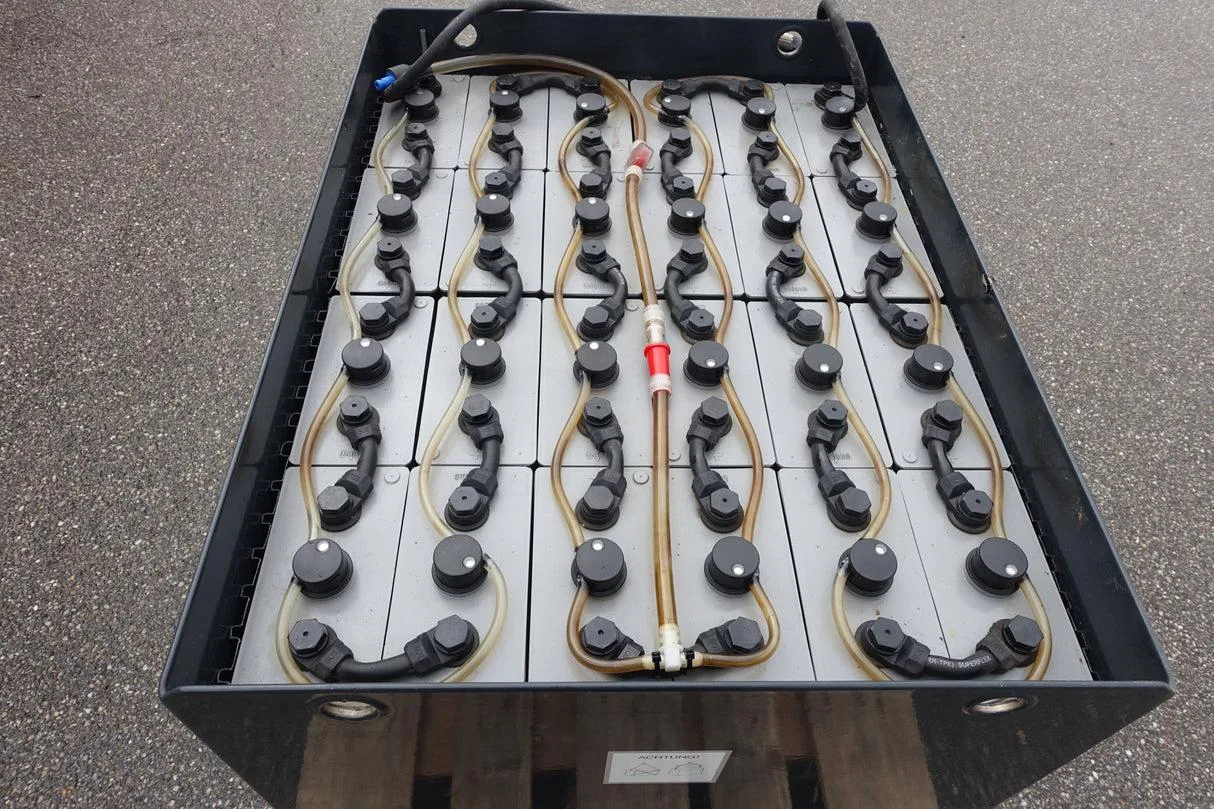
Traction batteries are rechargeable energy storage systems designed to power electrically driven vehicles and industrial equipment.
They are widely used in electric forklifts, pallet trucks, stackers, golf carts, industrial cleaning equipment and automated material-handling systems.
Unlike conventional automotive starter batteries, traction batteries are designed to deliver energy throughout repeated operating cycles rather than primarily providing short bursts of current for engine starting.
Traditional industrial traction batteries commonly use lead-acid chemistry, while lithium iron phosphate (LiFePO4) technology is increasingly used in applications requiring compatible charging systems, electronic battery management and flexible operating schedules.
This article explains the different types of traction batteries, their operating principles and the most important considerations when selecting an industrial battery system.
1. What Is a Traction Battery?
A traction battery is a rechargeable battery designed to provide electrical energy for vehicle propulsion and, where applicable, auxiliary functions such as hydraulic lifting.
Traction batteries are also known as motive-power batteries.
They are engineered for applications involving:
Repeated charge and discharge cycles
Sustained energy delivery
Variable electrical loads
Industrial operating conditions
Frequent equipment movement and vibration
In an electric forklift, for example, the traction battery may supply both the drive motor and hydraulic lifting system.
The battery's design must account for energy capacity, current delivery, mechanical installation and the operating environment.
2. Traction Batteries vs Starter and Stationary Batteries
Although different battery categories may share similar electrochemical principles, their intended applications differ significantly.
| Feature | Traction Battery | Starter Battery | Stationary Battery |
|---|---|---|---|
| Primary purpose | Electric propulsion | Engine starting | Standby or energy storage |
| Operating pattern | Repeated cycling | Short high-current bursts | Standby or application-specific cycling |
| Deep-discharge capability | Designed according to duty requirements | Generally unsuitable | Depends on design |
| Mechanical requirements | Vehicle movement and vibration | Automotive conditions | Usually fixed installation |
| Typical use | Forklifts, pallet trucks | Combustion-engine vehicles | UPS, telecommunications |
A deep-cycle battery designed for another application is not automatically a suitable replacement for an industrial traction battery.
3. Main Types of Traction Batteries
3.1. PzS Flooded Lead-Acid Traction Batteries
PzS cells use tubular positive plates and flooded lead-acid electrolyte.
They are commonly found in traditional industrial traction battery systems.
Key characteristics include:
Approximately 2V nominal voltage per cell
Tubular positive plate construction
Liquid sulfuric-acid electrolyte
Regular electrolyte maintenance
Designed for repeated industrial duty cycles
Their rated capacity is commonly expressed using the C5, or five-hour, discharge rate.
3.2. PzB Traction Batteries
PzB cells are another family of flooded tubular-plate lead-acid traction batteries.
They operate on similar principles to PzS cells but may follow different dimensional series.
A PzB cell and a PzS cell with the same voltage and capacity are not necessarily physically interchangeable.
Cell dimensions and battery tray compatibility must be verified.
3.3. PzV Gel Traction Batteries
PzV cells are valve-regulated lead-acid traction cells with immobilized gel electrolyte.
Compared with conventional flooded cells, they do not require routine electrolyte watering.
However, they still require:
An appropriate charging profile
Temperature management
Correct electrical protection
Suitable ventilation and safety provisions
Valve-regulated construction does not eliminate every possible gas-release or charging hazard.
3.4. LiFePO4 Lithium Traction Batteries
Lithium iron phosphate batteries are used in a growing range of industrial motive-power applications.
A typical LiFePO4 cell has a nominal voltage of approximately 3.2V.
For example, sixteen cells connected in series provide a nominal system voltage of 51.2V.
Potential benefits include:
Long cycle-life potential
High energy efficiency
Electronic cell monitoring
Reduced routine electrolyte-related maintenance
Opportunity charging in compatible systems
Application-specific battery control and communication
LiFePO4 battery systems require suitable electrical integration, a properly configured BMS and compatible charging equipment.
Battery weight and the vehicle's stability requirements must also be considered.
4. Comparison of Traction Battery Technologies
| Feature | Flooded Lead-Acid | Gel Lead-Acid | LiFePO4 |
|---|---|---|---|
| Typical cell voltage | 2V | 2V | 3.2V |
| Electrolyte watering | Required | Not required | Not required |
| Energy density | Generally lower | Generally lower | Generally higher |
| Initial cost | Generally lower | Product-dependent | Generally higher |
| Charging flexibility | Limited by battery requirements | Profile-dependent | Potentially more flexible |
| Cycle life | Use-dependent | Use-dependent | Can be longer under suitable conditions |
| Battery management | Application-dependent | Application-dependent | BMS required |
| Mechanical integration | Existing vehicle designs may accommodate it | Design-dependent | Requires compatibility evaluation |
No single battery technology is the best solution for every application.
A suitable choice depends on operating hours, charging infrastructure, energy requirements, maintenance capability and total cost of ownership.
5. Where Are Traction Batteries Used?
Electric Forklifts
Traction batteries provide energy for electric drive systems and hydraulic lifting functions.
In multi-shift operations, available battery energy and charging schedules directly influence operational continuity.
Electric Pallet Trucks
Electric pallet trucks rely on compact batteries that fit their mechanical design while supplying sufficient energy for transport operations.
Electric Stackers
Electric stackers require battery systems capable of supporting variable drive and lifting loads.
Appropriate current capacity and protection are important for reliable performance.
Golf Carts and Light Electric Utility Vehicles
Golf carts and similar vehicles use traction batteries to power their drive systems.
Battery sizing influences operating range, vehicle weight and charging requirements.
Industrial Cleaning Equipment
Floor scrubbers and sweepers may use traction battery systems designed for repeated operating cycles.
AGVs and Mobile Robots
Automated guided vehicles (AGVs) and certain autonomous mobile robots (AMRs) use application-specific battery packs.
These systems may also require battery communication, automated charging and integration with supervisory control systems.
6. How Is Traction Battery Capacity Calculated?
Battery capacity is often expressed in ampere-hours (Ah), while stored energy is usually expressed in kilowatt-hours (kWh).
The basic nominal energy calculation is:
Energy (kWh) = Nominal Voltage (V) × Capacity (Ah) / 1000
Example: 48V 500Ah Traction Battery
48 × 500 / 1000 = 24 kWh
The calculated nominal energy is 24 kWh.
Actual usable energy depends on battery chemistry, temperature, discharge rate, allowable depth of discharge, battery condition and system losses.
Understanding the C5 Rating
Traditional lead-acid traction battery capacity is commonly rated at the five-hour discharge rate, known as C5.
For a battery rated at 500Ah C5:
500Ah / 5 hours = 100A
This represents the reference discharge current under the specified test conditions.
Capacity ratings measured using different discharge periods, such as C5 and C20, should not be compared as if they were identical.
7. What Determines Traction Battery Prices?
Traction battery pricing depends on several factors beyond nominal voltage and Ah capacity.
Important cost factors include:
Battery chemistry
Energy capacity
Continuous and peak current capability
Cell configuration
Battery enclosure design
Electronic protection and BMS
Charging equipment
Communication requirements
Testing and applicable compliance work
Installation and integration requirements
A meaningful comparison should consider the complete battery system and its lifetime operating costs.
8. Converting Lead-Acid Traction Batteries to Lithium
Replacing a conventional lead-acid traction battery with a LiFePO4 system may be technically feasible in certain industrial vehicles.
Before conversion, the following should be evaluated:
Vehicle operating voltage range
Continuous and peak power requirements
Minimum and maximum battery weight
Battery compartment dimensions
Charger compatibility
BMS and communication requirements
Electrical protection and connector specifications
Manufacturer requirements and applicable approvals
Battery weight deserves particular attention in electric forklifts because it may contribute to vehicle stability.
A lighter lithium battery must not be installed solely on the assumption that lower weight is always beneficial.
9. Battery Maintenance and Safety
For flooded lead-acid batteries, appropriate electrolyte maintenance, charging procedures, ventilation and inspection are essential.
Gel batteries eliminate routine electrolyte watering but still require correct charging and safety procedures.
LiFePO4 systems require suitable BMS protection, temperature monitoring, electrical connections and manufacturer-approved charging arrangements.
In every case, equipment operators should follow the applicable battery and vehicle manufacturer's instructions.
10. Relevant Technical Standards
IEC 60254-1 addresses general requirements and test methods for lead-acid traction batteries.
IEC 62485-3 addresses safety requirements associated with traction batteries and their installation, use and maintenance.
IEC 62619 specifies safety requirements and tests for rechargeable lithium batteries used in industrial applications.
A reference to a standard does not constitute evidence that a particular battery product is certified or compliant. Product-specific documentation must be verified.
Frequently Asked Questions
What is a traction battery used for?
A traction battery powers the drive system of an electric vehicle or industrial machine. Applications include forklifts, pallet trucks, stackers, golf carts and certain automated vehicles.
Is a forklift battery a traction battery?
Yes. A forklift battery used to supply propulsion energy is a traction battery. However, traction batteries are also used in many other types of electric equipment.
What is the difference between PzS and PzV batteries?
PzS cells use flooded lead-acid electrolyte and tubular positive plates. PzV cells are valve-regulated lead-acid batteries using gel electrolyte. Their maintenance and charging requirements differ.
Can a lead-acid traction battery be replaced with LiFePO4?
In certain applications, yes. However, voltage, current, weight, dimensions, charging infrastructure, BMS communication and vehicle manufacturer requirements must all be evaluated.
How long does a traction battery last?
Battery life depends on chemistry, operating temperature, depth of discharge, charging conditions, maintenance and duty cycle. No universal service-life figure applies to every traction battery.
Why do traction battery prices vary?
Prices vary according to chemistry, capacity, current rating, mechanical design, electronic protection, integration requirements and the scope of supply.
Conclusion
Traction batteries are fundamental components of modern electric material-handling and industrial transport equipment.
Choosing the right battery requires an understanding of the machine's electrical requirements, operating conditions and maintenance needs.
Traditional lead-acid technologies remain relevant, while LiFePO4 solutions provide an alternative for compatible applications.
Looking for an Industrial Lithium Traction Battery Solution?
Mastiff Energy focuses on LiFePO4 battery engineering and solutions for industrial equipment, electric vehicles and material-handling applications.
Share your equipment model, current battery specifications and operating requirements to request a technical assessment.